Sunday, March 15, 2009

Independent Reading Post 2


Prompt: 1
Chapters: 3 & 4

I particulary liked the Chapter titled "Paris". Paris was one of the first places that Bryson traveled to on his journey, and having been to Paris before I appreciated his ability to mention not only the well known tourist attractions but also the small little shops and cafes that define Paris. Paris is such a beautiful and magical city and Bryson pays tribute to that very well. Bryson talks about the famous Notre Dame cathedral and well as the Louvre, the worlds largest art museum. He also speaks to the smaller and less well known attractions that the city has to offer.
He spends much time commenting on the quaint little bookstore called Shakespeare and Company. While in Paris, I visited the bookstore and he describes it perfectly, "... (I) wandered across the river to Shakespeare & Co., a wonderfully gloomy English-language book store full of cobwebs and musty smells and old forgotten novels by writers like Warwick Deeping. Plump chairs and sagging sofas were scattered about the rooms and on each a young person in intellectual looking glasses was curled up reading one of the proprietor's books, evidently from cover to cover," (page 43).
Besides mentioning the places and events going on in the city, Bryson does not forget to speak about the people of the city. He comments on the death traps that tourists find themselves in while trying to cross one of the many squares in the city while finding themselves surrounded by rude and unsympethetic drivers. He also comments on the inability that French people have to line up correctly, and how it is simply puzzling to him. What made this chapter so enjoyable was that Bryson touched on every aspect to the city, the people, the places, and the events, which allowed the reader to gain a clear perspective on the culture of the city.


Thursday, March 12, 2009

Theme #6 Introduction

I thought the 3rd website (http://www.fas.harvard.edu/~wricntr/documents/Thesis.html) was the most useful because it stated the process of writing a thesis and not just examples. While the other sites with examples were helpful they didn't really explain the process of getting from the topic to the thesis like this website did.

Thesis for Theme:
Ernesto aspired to be someone who would make a difference while living a carefree, adventurous lifestyle. While Ernesto’s intentions of who he wanted to become were pure and valid, he let others influence him into someone corrupt and malicious, thus impacting the world in a ruinous, damaging way.

Tuesday, March 10, 2009

Peru Diction Quiz

Che’s travels through Peru were not unlike the other places that he traveled to. During this section Che focused extensively on the culture and history of Peru and the native peoples of Peru. Their journey through Peru started out just like their journeys through Argentina and Chile, very carefree and not quite sure of where or how they would end up. They soon realized that it was slightly harder to get free stuff such as shelter and food than it had been in other countries. They were AFFRONTED many times when people tried to charge them for a ride. They came upon the Civil Union, and road in a truck with them throughout a good part of Peru. When Che and Alberto were in Juliaca they were speaking to a drunken sergeant and he was EVOKING anger from Alberto and the sergeant ended up causing some type of damage to the wall. The civilians in the bar blamed it on Alberto and one lady said, “These Argentines think they own everything” (page 101). This was one of the first incidents in which Che and Alberto were not embraced and were shown disrespect for being foreigners. After this incident they continued on their journey. Che kept mentioning how cold it was and how with each DAUNTING peak that they climbed they got colder and colder. Che describes the PLACID Lake Titicaca and his sail around the lake that means so much to the Incan culture. The men soon arrived at the IDYLLIC city of Cuzco in which Che spent a lot of time describing. He stated that it was the perfect city and kept describing how much it had to offer. He stated that there are three Cuzcos, “But there are 2 or 3 Cuzcos, or it’s better to say, 2 or 3 ways the city can be summoned…This is the Cuzco inviting you to become a warrior and to defend, club in hand, the freedom and life of the Inca…This Cuzco invites you to be a hesitant tourist, to pass over things superficially and relax into the beauty beneath a leaden winter sky… This is the Cuzco asking you to pull on your armor and, mounted on the ample back of a powerful horse, cleave a path through the defenseless flesh of a naked Indian flock whose human wall collapses and disappears beneath the 4 hooves of the galloping beast.” (Page 103/104). As much time as Che spent describing the city of Cuzco itself, he also spent describing the lives of the natives of Cuzco, the Incas. He described them as natives who were mysterious, intelligent, and pure experts when it came to living off of what they had. He described the ENIGMATIC Incan RELIC called Machu Picchu, of which to this day the real reason behind it is unclear. Machu Picchu was built on top of a high peak in the Peruvian Andes and many theories try to explain the reason for its existence. Che explained both the religious argument and the defense argument. Che and Alberto continue on their journey, and it seems as though they see greater amounts of poverty in Peru than anywhere else. They learn about the Peruvian Indian way of life and its faulty education system, as well as BESTIAL treatment of the Indians. As their journey continues Che describes how he and Alberto got their way to get free food and shelter down to a science. They called it the “anniversary routine” in which they were able to cop people out of food and into giving them a place to stay for the night. One of their final stops in Peru was to the San Pablo leper colony. In a letter Che wrote to his father he described the way that helping these people makes him feel, as though he is the greatest man in the world. The said that the way they look at him with INTERMINABLE gratefulness that he looked past their LESIONS and treated the as human beings was the best reward that he could of received. The lepers were used to being treated ABHORRENTLY, and they embraced Che and Alberto for treating them kindly. Their journey through Peru ended with them boarding the Mambo-Tango raft on the Amazon en route to Colombia.

Monday, March 9, 2009

Essential Question #2

Ernesto was someone who wanted to make a difference. He wanted to explore and to go on adventures and be care-free but he also wanted to help people. He was a doctor and he wanted to be able to help people who others wouldn't help, which is why he focused and was so keen on helping those with leprosy. Ernesto's journey throughout The Motorcycle Diaries explored both the care-free and adventurous side of him and the helping side. I don't think that he was aiming to have the impact that he did. While helping the rebellion to overthrow Batista, Che was executing his adventurous and helping sides, but he did in a rough manner which gave him a bad reputation. He impacted the world in a way that I don't think he was expecting to. He let the power get to his head, and felt that it was necessary to end the lives of those against him. He totally switched from what he was in Motorcycle Diaries to what is known for today. He let Castro influence him and use him as his personal puppet while losing sight of his original goals.

Friday, March 6, 2009

Independent Reading Post 1

Prompt: 11
Chapters: 3 & 4

"The hotel was one of those sterile, modern places that always put me in mind of a hospital, but at least it didn't have the curious times switches that used to be a feature of hotel hallways in France. These were a revelation to me when I first arrived from America/ All the light switches in the hallways were timed to go off after ten or fifteen seconds, presumably as an economy measure. These were a revelation to me when I first arrived from America. This wasn't so bad if your room was next to the elevator, but if it was very far down the hall, and hotel hallways in Paris tend to wander around like an old man with Alzheimer's, you would generally proceed the last furlong in total blackness, feeling your way along the walls with flattened palms, and invariably colliding scrotally with the corner of a nineteenth-century oak table put there, evidently, for the purpose. Occasionally, your groping fingers would alight on something soft and hairy, which you would recognize after a moment as another person, and if he or she spoke English, you could exchange tips....And from this I learned one very important lesson: The French do not like us." (page 40/41)

This quote exemplifies Bill Bryson's style. He can take any situation, ie light switches, and turn it into a funny description of a bigger idea. There is a quote on the back of the book, from the Chicago Sun-Times, that praises Bryson and describes his style exactly, "Bill Bryson could write an essay about dryer lint or fever reducers and still make us laugh out loud." He describes events and objects that most people have never encountered in a unique and humorous way that makes everyone want to experience it. Bryson's style is definitely effective, as it always gets his point across. He can take the most boring subjects and make his reader focus and understand his point using humor. His style adds to my enjoyment of the book because I find myself laughing out loud and just wanting to read more and see what humorous situations he gets himself into next.

Thursday, March 5, 2009

Independent Reading Introduction Post


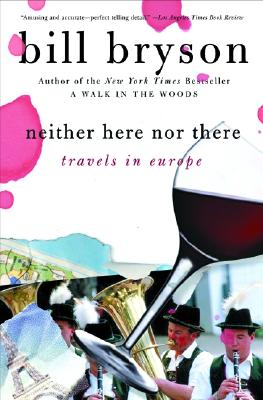
Title: Neither Here Nor There
Author: Bill Bryson

I will be reading Neither Here Nor There by Bill Bryson for my independent reading project. The book is a travel diary about Bryson's trip through Europe. Bryson is also famous for other such travel diaries, such as a Walk in the Woods which is about his journey on the Appalachian Trail. I chose to read this book because I have read other books by Bill Bryson and they are absolutely hilarious yet informative and make for a great read. The task is to convey, using blog posts, the overall plot and interesting points in the book. These blog posts will present the interesting, confusing, surprising, and moving events and ideas presented in the book.

Wednesday, March 4, 2009

Chile


One experience that Che had in Chile that could affected his later life would be when him and Alberto decided to sneak on the boat, the San Antonio, to try to get to Easter Island. This may have affected his later life because it was an experience that he was doing illegaly but people still accepted him with open arms. Although they snuck on the boat and could have gotten in a lot of trouble the captain embraced them with no bad consequences. "He recommended that we say nothing about our previous meeting and that he would ensure nothing happened when we arrived in Antofagasta, the ship's destination. He let us sleep in the cabin of an officer on leave, and that night invited us to play canasta and have a drink or two," (page 75). One major impact that this may have had on Che would be to build his ego to think that he was above the law, and also to fuel his sense of rebelliousness.