Showing posts with label Independent Reading. Show all posts
Showing posts with label Independent Reading. Show all posts
Monday, April 27, 2009
Independent Reading Blog Post 1
For my independent reading project I am reading Harry Potter and the Chamber of Secrets. I like the book a lot because it has a unique story line that is unlike any other book. The writing is fantastic and JK Rowling does an amazing job at describing all of the magical elements so that they are all believable. I definitely think that I will enjoy this book and I'm not considering switching my choice.

Tuesday, March 31, 2009
Independent Reading Post 10
Prompt: 16
Chapters: WHOLE BOOK
This marking period we have been reading The Motorcycle Diaries, by Ernesto Che Guevara, in class. The Motorcycle Diaries was about a care-free Argentine adventurer who traveled around Latin America in search of thrills. This relates very well to Neither Here Nor There because Bill Bryson was extremely adventurous and courageous and left everything he knew to go on this trip, just like Che did. Bryson's care-free attitude led him through many peculiar situations just like Che. While Che didn't comment so much on the people of the countries and what made them unique, he did describe landscapes and events in terrific detail just like Bryson. It is very easy to see the parallels between the two travel diaries.
Chapters: WHOLE BOOK
This marking period we have been reading The Motorcycle Diaries, by Ernesto Che Guevara, in class. The Motorcycle Diaries was about a care-free Argentine adventurer who traveled around Latin America in search of thrills. This relates very well to Neither Here Nor There because Bill Bryson was extremely adventurous and courageous and left everything he knew to go on this trip, just like Che did. Bryson's care-free attitude led him through many peculiar situations just like Che. While Che didn't comment so much on the people of the countries and what made them unique, he did describe landscapes and events in terrific detail just like Bryson. It is very easy to see the parallels between the two travel diaries.
Independent Reading Post 9
Prompt: 17
Chapters: WHOLE BOOK
Neither Here Nor There is a book that is not rich in symbols and themes and big ideas. It's rich in description and setting, as a travel diary should be. Everything that happens and that is discussed in the novel is a result of where Bryson is, thus setting is probably the most important aspect of this story. The people he describes, the events he partakes in, and the other cultural aspects that he describes are all based off of the setting. Therefore, the plot is based off of the setting. A travel diary should be primarily based off of the setting, so this book conforms very nicely to this.
Chapters: WHOLE BOOK
Neither Here Nor There is a book that is not rich in symbols and themes and big ideas. It's rich in description and setting, as a travel diary should be. Everything that happens and that is discussed in the novel is a result of where Bryson is, thus setting is probably the most important aspect of this story. The people he describes, the events he partakes in, and the other cultural aspects that he describes are all based off of the setting. Therefore, the plot is based off of the setting. A travel diary should be primarily based off of the setting, so this book conforms very nicely to this.
Independent Reading Post 8
Prompt: 18
Chapters: 21 & 22
"At the same time, I had a quite irrational urge to keep going. There is something about the momentum of travel that makes you want to just keep moving, to never stop. That was Asia over there, after all-right there in my view. The thought of it seemed incredible. I could be there in minutes. I still had money left. An untouched continent lay before me. But I didn't go. Instead, I ordered another Coke and watched the ferries. In other circumstances, I think I might have gone. But that of course is neither here nor there." (page 245)
The last sentence of the above quote, "But that of course is neither here nor there," is where the title of the book most likely came from. Towards the end of the book, Bryson is speaking about how he could have kept traveling but it was his choice not to. The last line alludes to that fact that Bryson does not regret not traveling more and does not regret stopping where he did. It seems to define the book well because it speaks to the care-free and spontaneous attitude that Bryson possessed on the trip, one with no regrets. I don't think I would change the title of the book because it is a title that speaks well to the main issues presented. However, if I had to change it I would maybe call it, "The ups, downs, ins and outs and everything else that you will ever need to know about Europe and it's people." I think this title also speaks well to what the book is about because Bryson truly does describe more than the stereotypical travel book, and he does so in a way that makes his reader understand fully what the culture of the country is like.
Chapters: 21 & 22
"At the same time, I had a quite irrational urge to keep going. There is something about the momentum of travel that makes you want to just keep moving, to never stop. That was Asia over there, after all-right there in my view. The thought of it seemed incredible. I could be there in minutes. I still had money left. An untouched continent lay before me. But I didn't go. Instead, I ordered another Coke and watched the ferries. In other circumstances, I think I might have gone. But that of course is neither here nor there." (page 245)
The last sentence of the above quote, "But that of course is neither here nor there," is where the title of the book most likely came from. Towards the end of the book, Bryson is speaking about how he could have kept traveling but it was his choice not to. The last line alludes to that fact that Bryson does not regret not traveling more and does not regret stopping where he did. It seems to define the book well because it speaks to the care-free and spontaneous attitude that Bryson possessed on the trip, one with no regrets. I don't think I would change the title of the book because it is a title that speaks well to the main issues presented. However, if I had to change it I would maybe call it, "The ups, downs, ins and outs and everything else that you will ever need to know about Europe and it's people." I think this title also speaks well to what the book is about because Bryson truly does describe more than the stereotypical travel book, and he does so in a way that makes his reader understand fully what the culture of the country is like.
Independent Reading Post 7

Prompt: 4
Chapters: 13 & 14
"Even the little didn't greatly disturb me. I know Rome is dirty and crowded and the traffic is impossible, but in a strange way that's part of the excitement. Rome is the only city I know, apart from New York, that you can say that about. In fact, New York is just what Rome reminds me of-it has the same noise, dirt, volubility, honking, the same indolent cops standing around with unfocused electric buzz of energy. The only difference is that Rome is so wondrously chaotic. New York is actually pretty well ordered. People stand in line, and for the most part obey traffic signals and observe the conventions of life that keep things running smoothly." (page 135)
One aspect of Bryson's writing that I enjoy is the way that he relates places and events that he knows most of his readers have never been to or experienced to things that most of his readers have experienced. In this case he is relating the lesser-known Rome to New York City, a place that many Americans reading this book would have been to. When he was describing Rome as a dirty and chaotic city it really surprised me. I wouldn't think that with all of the wonderful history and tourist attractions that Rome has to offer that it would be like New York City. I thought it was more of a sacred and clean city rather than like New York. I am going to Rome this summer so I will be very interested to see if it actually parallels to New York City.
Monday, March 30, 2009
Independent Reading Post 6
Prompt: 2
Chapters: 11 & 12
"On top of that, the Swedes and Norwegians have shackled themselves with some of the most inane and restrictive laws imaginable, laws that leave you wondering what on earth they were thinking about. In Norway, for instance, it is illegal for a bartender to serve you a fresh drink until you have finished the previous one. Does that sound to you like a matter that needs to be covered by legislation? It is also illegal in Norway for a bakery to bake bread on a Saturday or Sunday. Well, thank God for that, say I. Think of the consequences if some ruthless Norwegian baker tried to foist fresh bread on people on the weekend. But the most preposterous law of all, a law so pointless as to scamper along the outer margins of the surreal, is the Swedish one that requires motorists to drive with their headlights on during the daytime, even on the sunniest summer afternoon. I would love to meet the guy who thought up that one." (page 121)
These laws confused me just as much as Bryson was confused by them. In America I think some laws are quite ridiculous, but I guess I can't complain until I live in Norway. These confusing laws spurred me to research more of Norway's laws and see if they were just as ridiculous. In Norway you are not allowed to drink in public, which even encompasses your own balcony if people can see you. Alcohol is also extremely pricey in Norway and a glass of wine/beer in a restaurant can be in the range of $12 (http://iguide.travel/Norway/Drinking). All of these laws puzzled me just like they puzzled Bryson. Who would ever think of these and why would the public allow them to rule? It will be interesting to see if Bryson runs into any other such situations in other countries.
Chapters: 11 & 12
"On top of that, the Swedes and Norwegians have shackled themselves with some of the most inane and restrictive laws imaginable, laws that leave you wondering what on earth they were thinking about. In Norway, for instance, it is illegal for a bartender to serve you a fresh drink until you have finished the previous one. Does that sound to you like a matter that needs to be covered by legislation? It is also illegal in Norway for a bakery to bake bread on a Saturday or Sunday. Well, thank God for that, say I. Think of the consequences if some ruthless Norwegian baker tried to foist fresh bread on people on the weekend. But the most preposterous law of all, a law so pointless as to scamper along the outer margins of the surreal, is the Swedish one that requires motorists to drive with their headlights on during the daytime, even on the sunniest summer afternoon. I would love to meet the guy who thought up that one." (page 121)
These laws confused me just as much as Bryson was confused by them. In America I think some laws are quite ridiculous, but I guess I can't complain until I live in Norway. These confusing laws spurred me to research more of Norway's laws and see if they were just as ridiculous. In Norway you are not allowed to drink in public, which even encompasses your own balcony if people can see you. Alcohol is also extremely pricey in Norway and a glass of wine/beer in a restaurant can be in the range of $12 (http://iguide.travel/Norway/Drinking). All of these laws puzzled me just like they puzzled Bryson. Who would ever think of these and why would the public allow them to rule? It will be interesting to see if Bryson runs into any other such situations in other countries.
Sunday, March 29, 2009
Independent Reading Post 5
Prompt:
Chapters: 9 & 10
"At all events, this relaxed and genial air was something that I hadn't associated with Germans before, at least not those aged over twenty-five. There was no whiff of arrogance here, just a quiet confidence, which was clearly justified by the material wealth around them. Those little doubts we've all had about the wisdom of letting the Germans become the masters of Europe evaporated in the Hamburg sunshine...I don't think I can altogether forgive the Germans their past, not as long as I can wonder if that friendly old waiter who brings me my coffee might once have spent his youth bayoneting babies or herding Jews into gas ovens. Some things are so monstrous as to be unpardonable. But I don't see how anyone could go to Germany now and believe for a moment that that could ever happen again. The Germans are becoming the new Americans-rich, ambitious, hardworking, health-conscious, sure of their place in the world." (page 100)
The way that Bryson just realized that the Germans are not like the way they were in the 1940s is moving because he came to a realization that made him think about the changing times. While he states that he may never be able to forgive the Germans for what they did, which most people wouldn't be able to do anyway, he does realize that it will never happen again. Her connects the Germans to the Americans which in itself is a way of forgiving them and pardoning them because he is seeing them in a new light. The way that Bryson described his realization is moving because anytime anyone can see the better in something or someone it is inspirational.
Chapters: 9 & 10
"At all events, this relaxed and genial air was something that I hadn't associated with Germans before, at least not those aged over twenty-five. There was no whiff of arrogance here, just a quiet confidence, which was clearly justified by the material wealth around them. Those little doubts we've all had about the wisdom of letting the Germans become the masters of Europe evaporated in the Hamburg sunshine...I don't think I can altogether forgive the Germans their past, not as long as I can wonder if that friendly old waiter who brings me my coffee might once have spent his youth bayoneting babies or herding Jews into gas ovens. Some things are so monstrous as to be unpardonable. But I don't see how anyone could go to Germany now and believe for a moment that that could ever happen again. The Germans are becoming the new Americans-rich, ambitious, hardworking, health-conscious, sure of their place in the world." (page 100)
The way that Bryson just realized that the Germans are not like the way they were in the 1940s is moving because he came to a realization that made him think about the changing times. While he states that he may never be able to forgive the Germans for what they did, which most people wouldn't be able to do anyway, he does realize that it will never happen again. Her connects the Germans to the Americans which in itself is a way of forgiving them and pardoning them because he is seeing them in a new light. The way that Bryson described his realization is moving because anytime anyone can see the better in something or someone it is inspirational.
Independent Reading Post 4
Prompt: 3
Chapters: 7 & 8
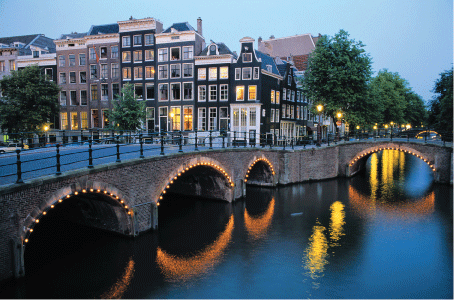
"When I was twenty I liked Amsterdam-indeed, admired it passionately-for its openness, its tolerance, its relaxed attitude to dope and sex, and all the other sins that on can't get enough of at twenty. But I found it oddly wearisome now. The people of Amsterdam were rather stuck with their tradition of tolerance, like people who take up a political stance and then have to defend it no matter how untenable it gets. Because the Dutch have been congratulating themselves on their intelligent tolerance for all these centuries, it is now impossible for them not to be nobly accommodating to graffiti and burned-out hippies and dog shit and litter. Of course, I may be completely misreading the situation. They may like dog shit and little. I sure hope so, because they've certainly got a lot of it." (page 89)
During his current journey around Europe Bryson recalls aspects of his last journey 20 years earlier. This is one example of him comparing the two trips. Since the passage of twenty years Bryson has grown a lot as a person and has experienced enough to make him change from the last time he traveled throughout Europe. As expected he is over the party phase that everyone goes through in their twenties, and now is happily married in his forties. He described his earliest trip through Europe as a care-free adventure with his buddy Katz and now he is going solo and learning more about himself. For example, as described in the quote above, he used to love the city of Amsterdam for its tolerance and freedom and now he doesn't want any part of it. He sees bad parts, like litter and graffiti, in the tolerance which are things he probably didn't even notice the first time that he was in the city. This exemplifies the changed Bryson.
Tuesday, March 24, 2009
Independent Reading Post 3
Prompt: 10
Chapters: 5 & 6
"I took three years of French in school, but learned next to nothing. The trouble was that the textbooks were so amazingly useless. They were always written by somebody clearly out of touch with the Francophile world-Professor Marvis Frisbee of the Highway 68 State Teachers College at Windstock, North Dakota, or something- and at no point did they intersect with the real world. They never told you any of the things you would need to know in France-how to engage a bidet, deal with a toilet matron, or kneecap a line jumper. They were always tediously preoccupied with classroom activities: hanging up coats in the cloakroom, cleaning the blackboard, opening the window, shutting the window, setting out the day's lessons. Even in the seventh grade I could see that this sort of thing would be of limited utility in the years ahead. How oftnn on a visit to France do you need to tell someone you want to clean a blackboard? How frequently do you wish to say: 'It is winter. Soon it will be spring.' In my experience, people know this already." (page 64)
This quote describes a phenomenon that I have questioned since 6th grade. I can totally connect to Bryson on this topic of useless foreign language textbooks. I have taken a Spanish class in school for 6 years and still can't speak a lick of the language, let alone enough to be usefull in a Spanish country. Bryson is completely correct in saying that the foriegn language textbooks focus on classroom activities and not usefull conversation. Bryson's frustration with this topic is very easy to connect to and the way he describes it is nothing short of perfect. Bryson connects this issue to his inability to eavesdrop on the French speaking people and what they are saying, which is something I think that I would be very frustrated with as well.
Chapters: 5 & 6
"I took three years of French in school, but learned next to nothing. The trouble was that the textbooks were so amazingly useless. They were always written by somebody clearly out of touch with the Francophile world-Professor Marvis Frisbee of the Highway 68 State Teachers College at Windstock, North Dakota, or something- and at no point did they intersect with the real world. They never told you any of the things you would need to know in France-how to engage a bidet, deal with a toilet matron, or kneecap a line jumper. They were always tediously preoccupied with classroom activities: hanging up coats in the cloakroom, cleaning the blackboard, opening the window, shutting the window, setting out the day's lessons. Even in the seventh grade I could see that this sort of thing would be of limited utility in the years ahead. How oftnn on a visit to France do you need to tell someone you want to clean a blackboard? How frequently do you wish to say: 'It is winter. Soon it will be spring.' In my experience, people know this already." (page 64)
This quote describes a phenomenon that I have questioned since 6th grade. I can totally connect to Bryson on this topic of useless foreign language textbooks. I have taken a Spanish class in school for 6 years and still can't speak a lick of the language, let alone enough to be usefull in a Spanish country. Bryson is completely correct in saying that the foriegn language textbooks focus on classroom activities and not usefull conversation. Bryson's frustration with this topic is very easy to connect to and the way he describes it is nothing short of perfect. Bryson connects this issue to his inability to eavesdrop on the French speaking people and what they are saying, which is something I think that I would be very frustrated with as well.
Sunday, March 15, 2009
Independent Reading Post 2

Prompt: 1
Chapters: 3 & 4
I particulary liked the Chapter titled "Paris". Paris was one of the first places that Bryson traveled to on his journey, and having been to Paris before I appreciated his ability to mention not only the well known tourist attractions but also the small little shops and cafes that define Paris. Paris is such a beautiful and magical city and Bryson pays tribute to that very well. Bryson talks about the famous Notre Dame cathedral and well as the Louvre, the worlds largest art museum. He also speaks to the smaller and less well known attractions that the city has to offer.
He spends much time commenting on the quaint little bookstore called Shakesp
 eare and Company. While in Paris, I visited the bookstore and he describes it perfectly, "... (I) wandered across the river to Shakespeare & Co., a wonderfully gloomy English-language book store full of cobwebs and musty smells and old forgotten novels by writers like Warwick Deeping. Plump chairs and sagging sofas were scattered about the rooms and on each a young person in intellectual looking glasses was curled up reading one of the proprietor's books, evidently from cover to cover," (page 43).
Besides mentioning the places and events going on in the city, Bryson does not forget to speak about the people of the city. He comments on the death traps that tourists find themselves in while trying to cross one of the many squares in the city while finding themselves surrounded by rude and unsympethetic drivers. He also comments on the inability that French people have to line up correctly, and how it is simply puzzling to him. What made this chapter so enjoyable was that Bryson touched on every aspect to the city, the people, the places, and the events, which allowed the reader to gain a clear perspective on the culture of the city.
Friday, March 6, 2009
Independent Reading Post 1
Prompt: 11
Chapters: 3 & 4
"The hotel was one of those sterile, modern places that always put me in mind of a hospital, but at least it didn't have the curious times switches that used to be a feature of hotel hallways in France. These were a revelation to me when I first arrived from America/ All the light switches in the hallways were timed to go off after ten or fifteen seconds, presumably as an economy measure. These were a revelation to me when I first arrived from America. This wasn't so bad if your room was next to the elevator, but if it was very far down the hall, and hotel hallways in Paris tend to wander around like an old man with Alzheimer's, you would generally proceed the last furlong in total blackness, feeling your way along the walls with flattened palms, and invariably colliding scrotally with the corner of a nineteenth-century oak table put there, evidently, for the purpose. Occasionally, your groping fingers would alight on something soft and hairy, which you would recognize after a moment as another person, and if he or she spoke English, you could exchange tips....And from this I learned one very important lesson: The French do not like us." (page 40/41)
This quote exemplifies Bill Bryson's style. He can take any situation, ie light switches, and turn it into a funny description of a bigger idea. There is a quote on the back of the book, from the Chicago Sun-Times, that praises Bryson and describes his style exactly, "Bill Bryson could write an essay about dryer lint or fever reducers and still make us laugh out loud." He describes events and objects that most people have never encountered in a unique and humorous way that makes everyone want to experience it. Bryson's style is definitely effective, as it always gets his point across. He can take the most boring subjects and make his reader focus and understand his point using humor. His style adds to my enjoyment of the book because I find myself laughing out loud and just wanting to read more and see what humorous situations he gets himself into next.
Chapters: 3 & 4
"The hotel was one of those sterile, modern places that always put me in mind of a hospital, but at least it didn't have the curious times switches that used to be a feature of hotel hallways in France. These were a revelation to me when I first arrived from America/ All the light switches in the hallways were timed to go off after ten or fifteen seconds, presumably as an economy measure. These were a revelation to me when I first arrived from America. This wasn't so bad if your room was next to the elevator, but if it was very far down the hall, and hotel hallways in Paris tend to wander around like an old man with Alzheimer's, you would generally proceed the last furlong in total blackness, feeling your way along the walls with flattened palms, and invariably colliding scrotally with the corner of a nineteenth-century oak table put there, evidently, for the purpose. Occasionally, your groping fingers would alight on something soft and hairy, which you would recognize after a moment as another person, and if he or she spoke English, you could exchange tips....And from this I learned one very important lesson: The French do not like us." (page 40/41)
This quote exemplifies Bill Bryson's style. He can take any situation, ie light switches, and turn it into a funny description of a bigger idea. There is a quote on the back of the book, from the Chicago Sun-Times, that praises Bryson and describes his style exactly, "Bill Bryson could write an essay about dryer lint or fever reducers and still make us laugh out loud." He describes events and objects that most people have never encountered in a unique and humorous way that makes everyone want to experience it. Bryson's style is definitely effective, as it always gets his point across. He can take the most boring subjects and make his reader focus and understand his point using humor. His style adds to my enjoyment of the book because I find myself laughing out loud and just wanting to read more and see what humorous situations he gets himself into next.
Thursday, March 5, 2009
Independent Reading Introduction Post
Title: Neither Here Nor There
Author: Bill Bryson
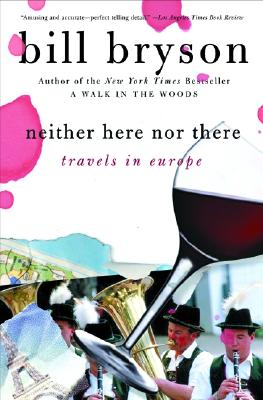
I will be reading Neither Here Nor There by Bill Bryson for my independent reading project. The book is a travel diary about Bryson's trip through Europe. Bryson is also famous for other such travel diaries, such as a Walk in the Woods which is about his journey on the Appalachian Trail. I chose to read this book because I have read other books by Bill Bryson and they are absolutely hilarious yet informative and make for a great read. The task is to convey, using blog posts, the overall plot and interesting points in the book. These blog posts will present the interesting, confusing, surprising, and moving events and ideas presented in the book.
Subscribe to:
Posts (Atom)